European shipyards and the self-destructive policy of 'No to State Aid'
Here’s how Europe handed over the lucrative shipbuilding business to Asia. And how the situation could get even worse
di FRANCESCO FERRARI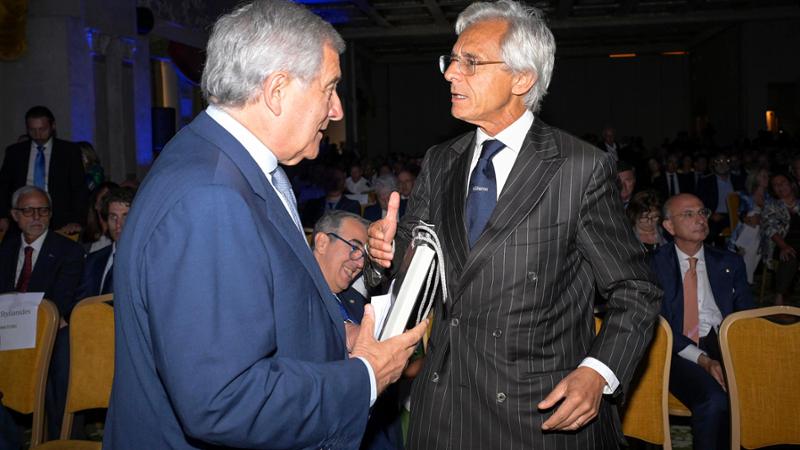
Italian Foreign Minister Antonio Tajani and Shipowners’ President Stefano Messina
(ansa)In a historical moment marked by geopolitical tensions, naval blockades, and fierce competition for control over trade routes, seeing the European shipbuilding industry reduced to just 4% of the global market is not merely an industrial defeat: it closely resembles a strategic surrender. Because shipbuilding is not just a business: it is a national security asset. And todayItaly, like the rest of Europe, finds itself without a clear vision: while it maintains global leadership in the cruise sector, it has almost completely vanished from the international stage when it comes to other types of commercial vessels.
Yet back in 1965, during the height of the economic boom, Europe built nearly half of the world's ships. Today, that record is a distant memory: China controls 53% of ship production, South Korea 27%, and Japan 14%. And Europe? A mere 4%, indeed. In a sector that continues to grow—shipbuilding production is expected to reach 74.1 million gross tons in 2025, compared to just 13 million sixty years ago—we’ve been pushed out without even putting up a fight.
The truth is that today, more than ever, we need a strong shipbuilding industry to manage the ecological transition, strengthen the European Union’s strategic autonomy, and protect our maritime economies.
Yesterday, Stefano Messina, president of Assarmatori, called for public intervention to renew the ferry fleet. The reasoning is simple, and one can only hope that the government representatives attending the association’s assembly understood it: the oldest ships must be replaced with newer, safer, and less polluting vessels. But without concrete support, these ships will continue to be ordered abroad, handing over more market share to the already thriving Asian industry.
So how should we proceed? Marco Bisagno, head of Italy’s largest private shipyard (Genoa-based Mariotti), summed it up in a few words: “We must support those who decide to dismantle a 40-year-old ship to build a new one that runs on cleaner fuels, or switches to electric when entering port.” A strategy that has already proven successful in the past. It’s a common-sense appeal that challenges the European dogma of “no state aid” in a world where everyone else, starting with China and the United States, does exactly the opposite.
I commenti dei lettori