DNV release annual reports on Energy Transition outlook
China is dominating much of the global action on decarbonization at present, particularly in the production and export of clean technology. It accounted for 58% of global solar installations and 63% of new electrical vehicle purchases last year. And whilst it remains the world’s largest consumer of coal and emitter of CO2, its dependence on fossil fuels is set to fall rapidly as it continues to install solar and wind. China is the dominating exporter of green technologies although international tariffs are making their goods more expensive in some territories
2024 will go down as the year of peak energy emissions*, according to DNV’s Energy Transition Outlook. Energy related emissions are at the cusp of a prolonged period of decline for the first time since the industrial revolution. Emissions are set to almost halve by 2050, but this is a long way short of requirements of the Paris Agreement. The Outlook forecasts the planet will warm by 2.2 °C by end of the century.
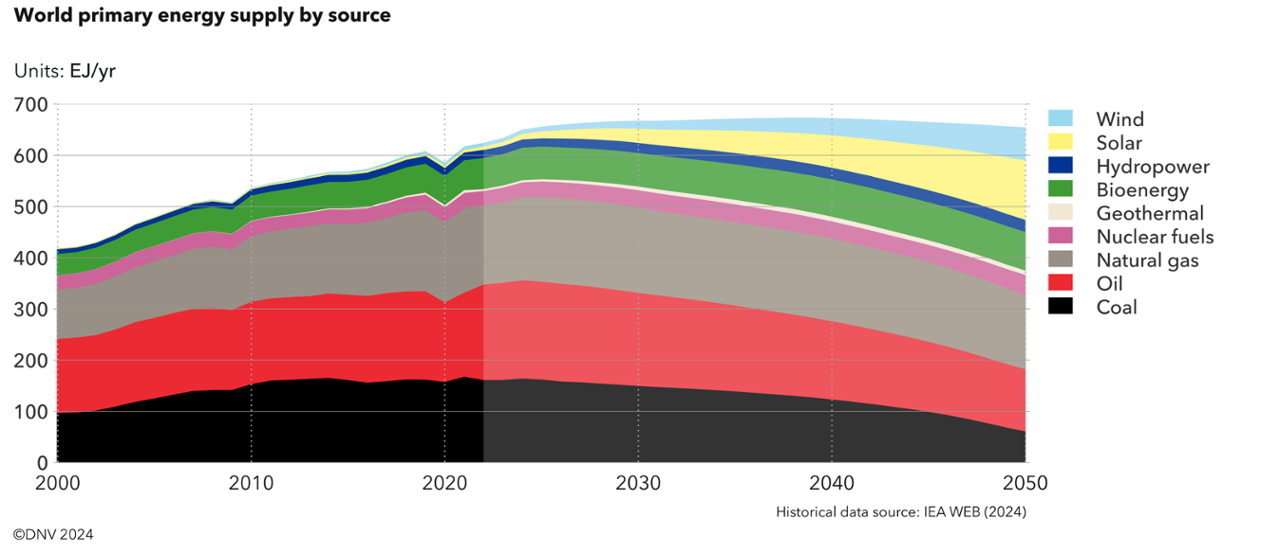
The peaking of emissions is largely due to plunging costs of solar and batteries which are accelerating the exit of coal from the energy mix and stunting the growth of oil. Annual solar installations increased 80% last year as it beat coal on cost in many regions. Cheaper batteries, which dropped 14% in cost last year, are also making the 24-hour delivery of solar power and electric vehicles more affordable. The uptake of oil was limited as electrical vehicles sales grew by 50%. In China, where both of these trends were especially pronounced, peak gasoline is now in the past.
China is dominating much of the global action on decarbonization at present, particularly in the production and export of clean technology. It accounted for 58% of global solar installations and 63% of new electrical vehicle purchases last year. And whilst it remains the world’s largest consumer of coal and emitter of CO2, its dependence on fossil fuels is set to fall rapidly as it continues to install solar and wind. China is the dominating exporter of green technologies although international tariffs are making their goods more expensive in some territories.
“Solar PV and batteries are driving the energy transition, growing even faster than we previously forecasted.” said Remi Eriksen, Group President and CEO of DNV. “Emissions peaking is a milestone for humanity. But we must now focus on how quickly emissions decline and use the available tools to accelerate the energy transition. Worryingly, our forecasted decline is very far from the trajectory required to meet the Paris Agreement targets. In particular, the hard-to-electrify sectors need a renewed policy push.”
DNV pubblica i rapporti annuali sulle prospettive della transizione energetica

Energy transition progressing despite challenges
The success of solar and batteries is not replicated in the hard-to-abate sectors, where essential technologies are scaling slowly. DNV has revised the long-term forecast for hydrogen and its derivatives down by 20% (from 5% to 4% of final energy demand in 2050) since last year. And although DNV has revised up its carbon capture and storage forecast, only 2% of global emissions will be captured by CCS in 2040 and 6% in 2050. A global carbon price would accelerate the uptake of these technologies.
Wind remains an important driver of the energy transition, contributing to 28% of electricity generation by 2050. In the same timeframe, offshore wind will experience 12% annual growth rate although the current headwinds impacting the industry are weighing on growth.
Despite these challenges, the peaking of emissions is a sign that the energy transition is progressing. The energy mix is moving from a roughly 80/20 mix in favour of fossil fuels today, to one which is split equally between fossil and non-fossil fuels by 2050. In the same timeframe, electricity use will double, which is also at the driver of energy demand only increasing 10%.
“There is a growing mismatch between short term geopolitical and economic priorities versus the need to accelerate the energy transition. There is a compelling green dividend on offer which should give policymakers the courage to not only double down on renewable technologies, but to tackle the expensive and difficult hard-to-electrify sectors with firm resolve,” added Eriksen
The Outlook also examines the impact of artificial intelligence on the energy transition. AI will have a profound impact on many aspects of the energy system, particularly for the transmission and distribution of power. And although data points are currently sparse, DNV does not forecast that the energy footprint of AI will alter the overall direction of the transition. It will account for 2% of electricity demand by 2050.
*CO2 emissions from the combustion of coal, oil and gas
Reports available for download at
The Maritime Forecast to 2050 is part of Energy Transition Outlook suite, with deep dive in Maritime industry and its challenges, being recently published and presented in Germany.
To reach IMO’s 2030 decarbonization goals shipping will need between 7 and 48 Mtoe of carbon-neutral fuels. However, with the global cross-sector production of carbon-neutral fuels expected to reach only between 44 and 63 Mtoe by 2030, it will be near impossible for shipping to secure its required share. As regulations like the EU Emissions Trading System (ETS) and FuelEU Maritime start to impose costs on emissions, shipowners and managers must therefore explore every option to reduce fuel consumption.
Knut Ørbeck-Nilssen, DNV Maritime CEO, said: "While we are currently witnessing a slowdown of decarbonization in shipping, we are entering an era of unprecedented technological exploration that will drive progress forward. With carbon-neutral fuels in short supply, smart decision-making and strategic investments today are crucial to lay the foundations for future emissions reductions. Prioritizing energy efficiency, leveraging technological solutions, and embracing digitalization are key steps towards reducing the extra cost burden and achieving our decarbonization goals."
The eighth edition of DNV’s Maritime Forecast to 2050 provides an updated outlook on regulations, drivers, technologies and fuels needed for maritime decarbonization, including four scenarios exploring conditions that could accelerate the adoption of specific fuels and technologies by 2050. The report emphasises that regardless of which direction the industry’s decarbonization journey takes, it will come at a significant cost. The four simulated scenarios project these cost increases per transport work; with estimates ranging from 69-75% for bulk carriers, 70-86% for tankers, and 91-112% for container vessels.
'Our latest analyses show that decarbonizing shipping could double the cost of transporting goods by containers”, said Eirik Ovrum, Principal Consultant and Lead Author of Maritime Forecast to 2050. “Ultimately, the rising costs of seaborne transport will need to be passed down the value chain and the market is already seeing trends towards shifting these costs to end-users. To remain competitive, shipowners must develop and execute strategic fleet management plans."
According to the report, reducing energy losses is the most straightforward way for the global fleet to cut emissions. Operational and technical energy efficiency measures can reduce fuel consumption by between 4 and 16% by 2030. Reducing energy consumption by 16% for the world fleet would save 40 Mt of fuel and 120 MtCO2 emissions, which would be equivalent to operating the 55,000 smallest ships or the 2,500 largest ships with carbon-neutral fuel.
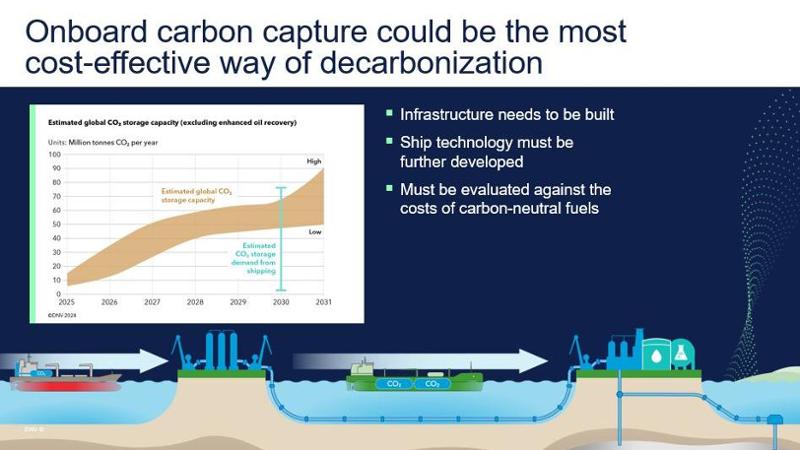
Furthermore, the report highlights onboard carbon capture (OCC) as potentially the most effective way to decarbonize as it enables the continued use of conventional fuels and technologies. However, CO2 handling infrastructure needs significant development. Solutions like shore power and batteries which can reduce reliance on costly carbon-neutral fuels are also highlighted. For instance, shore power can cut the 7% of total energy consumption that ships use in ports by replacing onboard fossil fuel-generated electricity.
Finally, the report emphasises the increasingly important role digitalization plays in complementing operational and technical energy efficiency measures. Digital verification tools are also crucial for establishing an infrastructure of trust, fostering industry-wide collaboration, and facilitating new contractual arrangements, incentivising energy savings.
“Our new report outlines how digitalization can shed light on vessel performance, providing vital data which shows the impact of energy saving measures. Data-driven decision making can then be used to design the next-generation of energy efficient ships which are key to the sector’s long-term success”, said Ovrum.
Reports available for download at
I commenti dei lettori