Ansaldo, the genius that Genoa wouldn’t recognise / GALLERY
Genoa - Isn’t it strange how details that seem insignificant can change one’s point of view and judgement about past events that determined who we are and shaped our character? The detail that has attracted my attention is the address on a letter sent from London by a young man to his wife
Giuseppe Marcenaro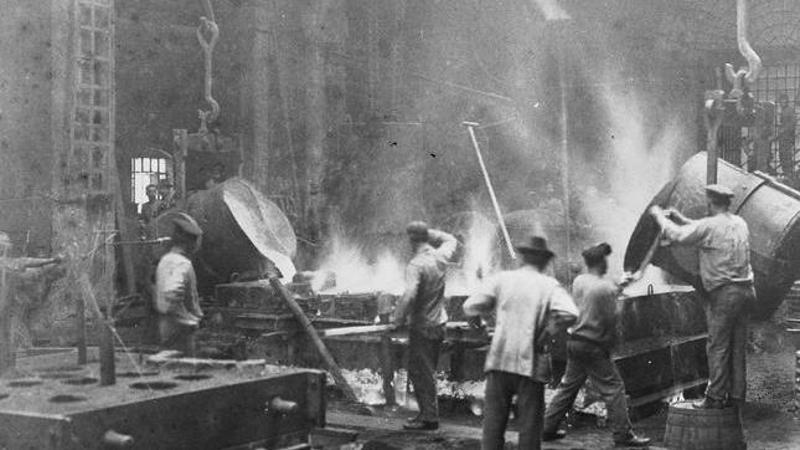
ansaldo gallery eng
Genoa - Isn’t it strange how details that seem insignificant can change one’s point of view and judgement about past events that determined who we are and shaped our character? The detail that has attracted my attention is the address on a letter sent from London by a young man to his wife. It is one of those missives without an envelope, folded in four, sealed with wax and still without a stamp. In the year in which the letter was written, 1851, stamps had already started to be used, but many still preferred to entrust their mail to couriers.
Out of pure pedantry I will say that the stamp was invented by the English in 1839 and began to be used in the Italian States between 1850 and 1852, there had been a forerunner used in the Kingdom of Lombardy-Venetia when it was under the dominion of Austria. What a strange fate for Genoa: an inevitable port appendix to the Kingdom of Sardinia. The most surprising thing, although it may seem absurd, is that in its search for redemption and of course its own identity and in the very years in which the mail first reached the Genoese with marks from the Kingdom of Sardinia, the project that captured the imagination of those beautiful people, and gave them hope that they could achieve some of their lost visibility, was to rejuvinate their life by building the Cemetery of Staglieno, a sumptuous city of the dead as a machine for historical and social redemption.
As luck would have it, in that city there were also men like Giovanni Ansaldo, a professor of Calculus at the university (of “sublime calculus,” as it was called at the time), appointed to the post with a licence from Carlo Alberto, the King of Sardinia. Ansaldo, born in 1818 in a family of the rising middle bourgeoisie, was a man who had turned his back on the complaints of his fellow citizens, and who out of love for his own city, where he was certainly proud to have been born, looked to Europe, to London, to Paris, and did not find it scandalous to recognise that Turin, a city that many Genoese held a grudge against, was an important model to follow.
On the other hand, there was capital. He was a man who had understood that one cannot give up and be discouraged by nostalgia for past glories or by natural indolence that prevents one from setting out on new adventures. The ancestral prudence of a race. After thirty years of slumber, with encouragement from Turin, Genoa was gradually awakening. A class made up of nobles who were in the process of becoming bourgeois and a new educated elite, no longer willing to live an anachronistic “wait-and-see” existence, was beginning to play an important role in the Kingdom of Sardinia.
Thanks to the House of Savoy’s international agreements, the merchant marine was given new impetus; a series of institutional reforms that aligned the Kingdom of Sardinia with Western European ideas and developments and led to the Albertine Statute of 1848 and the arrival of a constitutional parliamentary system. The social and political fabric of the Italian State was gradually being developed. Genoa began to experience a commercial and industrial renaissance thanks to men like Carlo Bombrini, Raffaele Rubattino and Giacomo Filippo Penco.
Men who the enterprising professor of mathematics, would have on board with him for the creation of his most ambitious industrial project only a few years later. Through holding public offices, Ansaldo participated in some innovative measures. With the preparation and implementation of the city and transportation plan for Genoa, he found himself at the centre of the project for the enlargement of the Portofranco, a railroad that connected Genoa to Turin, and in the creation of Genoa’s train station.
These convictions led him to get involved, as a professor of applied mechanics in the arts, in the technical night school for adults created in 1846 by the Chamber of Commerce; and to accept the appointment, in August of 1851, as the companion to a group of workers sent to London by the Sardinian government for educational purposes to visit the first World’s Fair held in the Crystal Palace, one of the wonders of the time. The letter that I referred to at the beginning, which was sent to the Kingdom of Sardinia, is one of those sent by Giovanni Ansaldo to his wife Giuditta, whilst on that trip. Ansaldo was taken by the fascination of the city and tells of his visit to the British Museum, crammed “with ancient sculptures that were in the Parthenon in Athens... In the library I saw the first book printed in Europe... alongside a letter from Charles I of England I saw one from Cromwell and another from Napoleon among Nelson’s and Wellington’s.”
After the trip to London his conviction became even stronger; it was the right moment to modernize all of Genoa’s transportation services as quickly as possible. The locomotive was the symbol of a new era. It was the perfect combination of steel and steam power and it was the image of the future. The Ligurian economy was finally becoming integrated into the Sardinian State and Ansaldo was more and more often called to Turin to participate in committees on industrial development, meeting Minister Paloecapa and the Count of Cavour, who had been following the enterprising Genoese’s activities for some time.
Eventually the moment came when the professor had to face the problems of entrepreneurship. In Sampierdarena, a mechanical production company, Taylor & Prandi, was in its death throes. Technically and economically, the company was unable to meet the industrial needs of the State. This is how, in August 1852, the metallurgical plant in Sampierdarena became State-owned and this established an agreement with Genoese representatives to start up a modern company.
There were four partners in the enterprise: Bombrini, Rubattino, Penco and Ansaldo, who was the only engineer. In the agreement established with the Government, it said that the sponsors were “moved by the desire to save a factory in our country that can contribute so much to the development of our nation’s industry, and the practical instruction of our workers.” The new company took the name Giovanni Ansaldo &C. At 34 years old, Ansaldo was managing the first Italian factory for the production of steam-powered locomotives. His son Francesco would write, based on the testimony of those who had known his father, who died when he was a child, “They say that he was a man with a dignified appearance, with a thick beard, a tireless smoker, frugal and thoughtful in his choice of words, and of a beautiful and clear intelligence...In his spare time his passions were art and history.”
However, Ansaldo’s activities inspired envy. As always, the people of Genoa failed to understand that the world had changed and reacted characteristically in response to a successful man.
The city hardly understood that Italy’s Risorgimento was taking on a new social dimension. A State in which the prime minister took care of the details and everyday matters as evidenced by the handwritten letter sent by Cavour to Giovanni Ansaldo: “this letter will be delivered to you by Mr. Magnaghi, who is a very intelligent agronomist and one of the sponsors of the use of the rice thresher in the irrigated provinces which is now doing such wonders for the cultivation of rice. He plans to introduce portable steam-powered wheat threshers into the area where he lives. And I have therefore advised him to seek you out for the construction of a 4 to 5 horsepower machine. I heartily recommend this little bit of business; since being successful he will exert an immense influence on agriculture in our provinces. I happily remain with noble feeling, your Devoted Servant C. Cavour.”
On 12 May 1859, Giovanni Ansaldo died suddenly at only 40 years of age. On the same day, Napoleon III landed in Genoa with French troops who joined the Piedmontese Army to fight Austria. That was the start of the Second Italian War of Independence. In that turmoil, of course, it didn’t cross anyone’s mind that the locomotives and railway wagons that carried the soldiers into battle so quickly had come from the Giovanni Ansaldo &C. factory in Sampierdarena.
And it was not only locomotives. Also steam engines, boilers from ships, turbines and the compressed air drilling machine for the opening of rail tunnels, the first of which was used in the Dei Giovi tunnel. An old house servant of Ansaldo’s, in her sorrow, went around saying that “Sir engineer was taken by illness because of machine trials he conducted on the Dei Giovi line, through which trains full of soldiers had to pass.”
I commenti dei lettori