Trieste and the IMEC Corridor: Italy at the heart of new global logistical equilibria
By ASLA - Associazione degli Studi Legali Associati
di Alberto Pasino*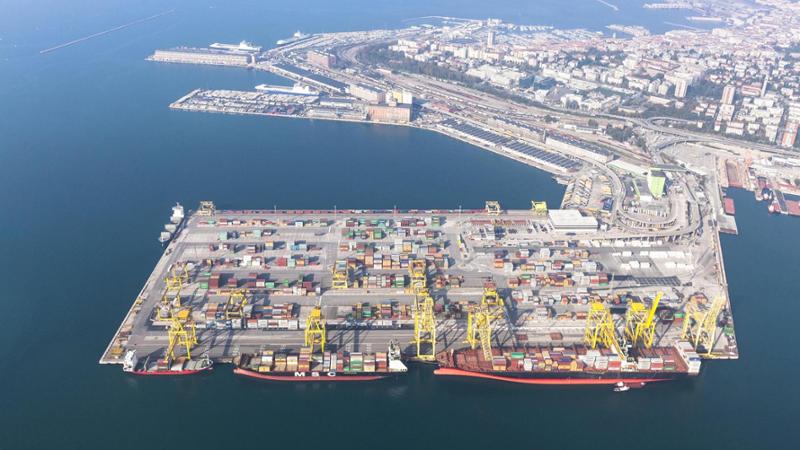
The port of Trieste
After decades of relative stability along major maritime routes, the grounding of the Ever Given in the Suez Canal starkly exposed the underlying fragility of today’s global trade architecture, a system heavily dependent on a limited number of highly vulnerable choke points whose operability directly determines the smooth flow of international commerce.
In this context, the Mediterranean today stands as a paradigmatic case: the world’s only maritime basin whose logistical centrality is directly tied to the simultaneous navigability of four strategic straits -Gibraltar, Bosporus-Dardanelles, Suez, and Bab al-Mandeb- as well as the still-structural impracticability of Arctic routes.
The Houthi attacks in Bab al-Mandeb and the looming threat of disruptions in the Strait of Hormuz have further heightened the vulnerability of the supply chain linking the Indian Ocean and Europe, prompting a fundamental rethinking of the transit options connecting the Arabian Sea with the Mediterranean. Within this scenario lies the strategic initiative to establish the India-Middle East-Europe Economic Corridor (IMEC), the result of an agreement signed on 9 September 2023 during the G20 Summit in New Delhi by the governments of Saudi Arabia, the European Union, India, the United Arab Emirates, France, Germany, Italy, and the United States. The IMEC Corridor aims to strengthen connectivity and economic integration between Asia, the Arabian Gulf and Europe through two principal axes: one connecting India to the Gulf and a second extending from the Gulf to Europe. Central to the initiative is the development of a new railway infrastructure, designed to complement and integrate existing maritime and road transport networks.

Along the rail route, the project envisions the laying of cables for electricity transmission and data flow, as well as pipelines for the transport of clean hydrogen.
The overarching objective is to create diversified and redundant trade routes that can mitigate the risks posed by vulnerable maritime choke points.
Politically, the vision backing the IMEC Corridor is that it "will start in India, pass through Israel and Italy, and continue to the United States, connecting our partners through roads, railways, and undersea cables" (Pres. Trump), with Trieste identified as its key European gateway.
It is precisely on this broad political consensus regarding Trieste’s strategic role that Italian diplomatic efforts are now focused. Following the appointment of Ambassador Francesco M. Talò as the Italian Government’s Special Envoy for IMEC, Foreign Minister Antonio Tajani recently announced an international event to be held in Trieste this coming autumn, aimed at further promoting the port’s role as Europe’s gateway of the corridor.
This recognition crowns the efforts already made by Trieste’s business and logistics community, which -through international forums such as the Raisina Dialogue in New Delhi and Marseille, as well as meetings in Washington and other global platforms- has consistently emphasized the unique features that make Trieste the ideal gateway for IMEC into the European heartland: its central geographic position, first-class infrastructure, extensive rail integration and one of the most dynamic hinterlands on the continent.
For historical reasons and by virtue of its trade profile, Trieste stands as Italy’s only port with an almost exclusively international vocation.
This distinctive identity traces back to the 1719 decision by Emperor Charles VI of Habsburg to grant Trieste free port status, driven by the imperial ambition to create material foundations for the Viennese monarchy’s commercial and colonial expansion toward the Levant and the Mediterranean, and to consolidate the political and economic unity of the Habsburg dominions -now the most dynamic segment of the European economy- through a Vienna-controlled network of trade, people and goods.
This legacy remains clearly visible in Trieste’s current trade flows: over 50% of containers and 70% of liquid bulk handled are destined for foreign markets, notably Austria, Southern Germany, the Czech Republic, Slovakia, and Hungary. The TAL pipeline originating in Trieste supplies Austria, the Czech Republic and Southern Germany with a substantial portion of their energy needs, confirming Trieste’s strategic role in Europe’s energy security. Located at the northernmost point of the Mediterranean, Trieste offers rapid access to Europe’s principal industrial and consumption centers: within a 500-kilometer radius lie major hubs such as Milan, Zurich, Munich, Vienna, Bratislava, Budapest, Ljubljana, Zagreb, and Prague — forming one of the most competitive logistical hinterlands in Europe. As Italy’s leading port for rail freight, overall cargo volume, petroleum imports and short sea shipping, Trieste boasts a highly integrated rail network with daily intermodal connections to key terminals across Central and Eastern Europe. Embedded within the European TEN-T multimodal corridors -notably the Baltic-Adriatic and Mediterranean Corridors- Trieste serves as a critical node for the logistical connectivity of Central and Eastern Europe. Its strategic positioning also makes it a natural southern platform for the Three Seas Initiative, strengthening North-South trade flows and enhancing the logistical resilience of the entire Adriatic-Baltic corridor.
Thanks to its deep natural draught and continuously expanding infrastructure, Trieste can accommodate the latest generation of ultra-large container vessels, consolidating its role as a primary Adriatic hub for Eurasian trade.
While Trieste naturally stands out as Europe’s ideal terminal for the IMEC Corridor, the project’s inherent logic of diversification and redundancy leaves room for additional Mediterranean ports serving different geographic segments.
In this perspective, Marseille may complement Trieste by handling cargo destined for Western Europe. The position of Piraeus, by contrast, remains more complex due to China’s substantial influence over the port, exercised through the Belt and Road Initiative, a project perceived as geopolitically competing with IMEC’s objectives.
For Italy, the operational launch of the IMEC Corridor offers a unique strategic opportunity to fully leverage Trieste’s specific strengths -a port whose international vocation, specialized traffic profile, and geopolitical positioning set it apart from the rest of the Italian port system- and to reconnect with a natural economic hinterland largely lost after the Second World War. This is a chance to reinforce Italy’s logistical and commercial role within both the Euro-Mediterranean and broader Eurasian frameworks, contributing to the security and diversification of global strategic flows.
*Zunarelli e Associati
I commenti dei lettori