"Msc World Europa" delivered: she’s the first cruise ship with fuel cells
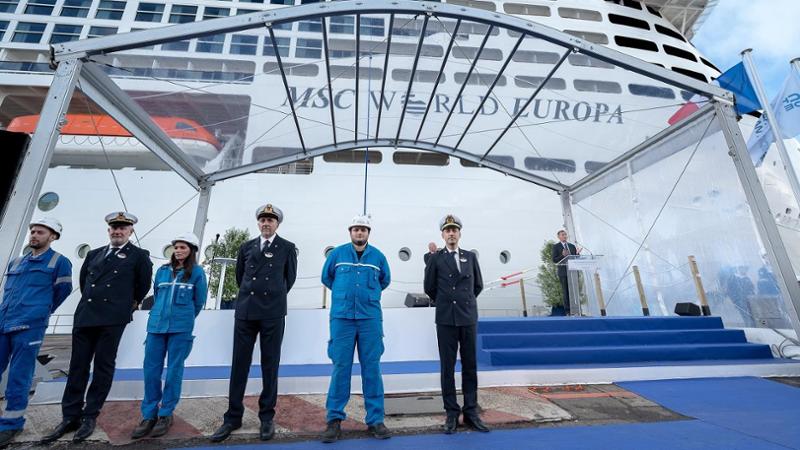
The "MSC World Europa" Ceremony
Saint-Nazaire - The Cruise Division of the MSC Group and the Chantiers de l'Atlantique celebrated today in Saint-Nazaire the delivery of the “MSC World Europa”, the most advanced and performing “green” cruise ship in the world.
Powered by liquefied natural gas, the "World Europa" is the first ship to incorporate fuel cell technology, which together with the use on board of numerous other cutting-edge ecological solutions, is able to significantly reduce overall environmental impact of the ship, almost completely eliminating emissions of atmospheric pollutants, including sulfur oxides and fine particles, and also significantly reducing nitrogen oxides and carbon dioxide emissions by up to 25%.
The delivery ceremony marked an important moment in the long-term collaboration between shipowner and shipyard, which led to the creation of the largest, most innovative and ecologically advanced cruise ship in the MSC Cruises fleet.
In addition to immediate progress in terms of emission reduction and energy efficiency, “World Europa” paves the way for the adoption of synthetic and alternative zero-emission fuels as soon as they are available on a large scale.
THE COMMON CONTRIBUTION TO THE FUTURE OF CRUISES
The "MSC World Europa" is the first ship of the new World Class and sets new standards for the cruise industry. It is, according to the MSC, "an ultramodern urban metropolis at sea that represents the future of the cruise industry, offering a world of different experiences and pushing the boundaries of what is possible at sea": Pierfrancesco Vago, executive president of the Cruise Division of the MSC group, says he is "proud to welcome 'World Europa', our 26th ship and the first LNG-powered, to the fleet. The unit represents the new phase of our journey towards zero emissions and sustainable cruises, symbolizing our unwavering commitment to this, as well as a decisive step forward for our Cruise Division, the entire MSC group and the cruise industry in the as a whole, thanks to numerous innovations from an environmental point of view, marine technology, design and solutions for guests. This ship is the result of over four years of collaboration between us, Chantiers de l'Atlantique and numerous leading suppliers in the field of next-generation environmental and maritime technologies, and together with thousands of hours of training for those operating both on board and in the ports. Now more than ever we need even closer collaboration with suppliers, governments and all stakeholders to continue our investments and take further steps towards the zero-emission future that we all want. The innovative technologies developed for our ships can in fact benefit society as a whole, as well as the cruise and shipping sector in general ".
For Laurent Castaing, general manager of Chantiers de l'Atlantique, "we have reached a new stage in the cruise industry with the 'World Europa', the largest ship ever built for a European shipowner. She is equipped with all the latest technologies to offer passengers an unprecedented experience. From a technological point of view, the unit is equipped with a liquefied natural gas (LNG) propulsion system, presenting a new level of performance and efficiency in the cruise industry. This is a milestone in the process of reducing emissions, as the “World Europa” is the ship that emits the least emissions of the entire cruise industry ".
THE FIRST CRUISE SHIP WITH FUEL CELLS
The “World Europa” is also the first contemporary cruise ship in the world to have a new solid oxide fuel cell (Sofc) technology powered by liquefied natural gas (LNG). The ship is equipped with a 150 kilowatt Sofc prototype that will use LNG to produce electricity and heat on board in a highly efficient way through an electrochemical reaction.
It will be a test bed for accelerating the development of fuel cell technology for contemporary cruise ships, offering the potential to enable hybrid propulsion solutions in the future: "We expect Sofc to reduce greenhouse gas emissions substantially compared to the conventional LNG engine, without producing nitrogen oxides, sulfur oxides or fine particles. Furthermore, it has the advantage of being compatible not only with LNG, but also with low and zero carbon content fuels, such as green methanol, ammonia and hydrogen. In the future we could also switch to synthetic LNG or other alternative fuels not a base of carbon," explains Linden Coppell, vice president of the Sustainability and ESG division of MSC Cruises.
THE FUEL OF TRANSITION
"We chose LNG because it is the cleanest marine fuel currently available, a transition fuel in view of the procurement and use of synthetic LNG or other non-carbon-based alternative fuels as they become available on a large scale" , says Vago.
Compared to standard marine fuels, LNG almost completely eliminates emissions of atmospheric pollutants, including sulfur oxides and fine dust, considerably reduces nitrogen oxides and already allows CO2 to be reduced by up to 25%. LNG will also enable the development of low-carbon fuels and solutions, such as green hydrogen, synthetic LNG and fuel cells.
ENERGY EFFICIENCY
In collaboration with the shipyard, the “World Europa” was designed with an innovative hull shape to minimize resistance in the water. The ship also incorporates a wide range of equipment to optimize energy use throughout the ship.
These include intelligent ventilation systems and advanced air conditioning systems, with automated energy recovery circuits, which allow effective distribution of heat and cold. The ship uses LED lighting, controlled by intelligent management systems to further improve the energy saving profile. It will also be equipped with automatic data collection systems for remote energy monitoring and advanced analysis, enabling real-time ground support to optimize operational efficiency on board.
These advances in terms of efficiency combined with the use of LNG will make it possible to achieve operational performance that exceeds the energy design criteria required by the International Maritime Organization for new ships. The Msc “World Europa” has been designed to achieve performance 47% higher than the energy efficiency design index (Eedi) required by the legislation.
OTHER INNOVATIONS
The “Msc World Europa” is equipped with an advanced waste water treatment system (AWTS) that meets the highest regulatory requirements in the world, including the so-called Baltic standard.
It treats all wastewater produced on board that reaches high standards equal to those of tap water. The ship also includes a state-of-the-art ballast water treatment system that prevents invasive species from entering the marine environment through drains, in accordance with the IMO Ballast Water Management Convention: "We have a 'entire crew dedicated to implementing rigorous waste management protocols by separating them into seven distinct types, such as glass, aluminum and paper, with specialized equipment to crush or bundle these types of waste in the ship's facility, ” Coppell says.
In addition, “World Europa” is equipped with a selective catalytic reduction (Scr) system which reduces nitrogen oxide emissions by 90% when LNG is not available and the ship has to run on marine diesel.
As LNG fuel achieves a similar reduction, “World Europa” will always be ready to meet IMO's Tier III NOx emissions standards. Like all new buildings of MSC Cruises, the ship is equipped with shore power, which makes it possible to minimize the use of engines in ports where the necessary infrastructure is available.
The hull and engine room of the MSC “World Europa” have been designed to minimize underwater acoustic impact, reducing the potential impact on marine mammals in the surrounding waters.
THE NEW GENERATION CRUISE
With state-of-the-art marine technologies and on-board hospitality services, "World Europa" will redefine the cruise experience with a never-before-seen offer and creative areas that are in no way inferior to today's ships.
The innovative design features a Y-shaped stern structure that leads to the Europa Promenade, which is 104 meters long, half open and half covered, with a view of the ocean. Balcony cabins overlook the stunning promenade, which features an architectural centerpiece in the form of The Venom Drop @ The Spiral, an 11-deck high slide, the longest at sea.
New additions to the MSC World Europa include a microbrewery, a gin bar, a healthy juice bar, a coffee emporium and a tea house. The ship offers 13 different dining options, including two new specialty restaurants, La Pescaderia, which will offer fresh seafood, and Chef's Garden Kitchen, which will offer seasonal cuisine ranging from farm to ocean.
"WORLD AMERICA" IS BORN
The name of the second world-class ship was also revealed today during cerimony of sheet metal cutting. It will be called "Msc World America" and will be destined for the North American market when it enters service in 2025.
This is further evidence of the company's commitment to targeting its newest ships in this important cruise market and providing US guests with a ship and experience tailored to them. The "MSC World America" will be the fourth new flagship to be deployed in this region.
I commenti dei lettori